Moncton and Québec - August 24, 2026 – This Conservation Harvesting Plan (CHP) presents management measures for herring licence holders using mobile gear. Licence holders must refer to their conditions of licence available on the National Online Licensing System (NOLS).
New in 2026
Management Approach per Sector (MAS)
The allocations for the mobile gear fleets are distributed in accordance with the Management Approach per Sector (see Chart 1) announced on July 3, 2026.
- North : 1,490 tonnes (t) with a maximum of 745 t inside Chaleur Bay
- Central : 688 t
- South : 1,376 t
Changes to Reporting of Lost / Retrieved Fishing Gear
Fisheries and Oceans Canada (DFO) is advising fish harvesters of changes in the conditions of licences related to lost and retrieved fishing gear. Please consult the document 2026 - Conditions of Licence : Changes to Reporting of Lost / Retrieved Fishing Gear for additional information.
Vessels greater than 19.81 metres
Other management measures
- The Dockside Monitoring Program (DMP) percentage coverage is 100%.
- The percentage of the spring spawners will be monitored for each fishing trip using a scientific protocol to determine catch composition (see Annex 1).
- The fall fishery for the large seiners will be closed for the season (for fleets using mobile gear) when either of the following occurs:
- exceeding 10% of spring spawner by-catch per fishing trip for two consecutive trips, or
- a total amount of 25 t of spring spawner by-catch has been caught.
- The purse seine fishery is subject to the small fish protocol.
- The logbook is mandatory (paper or electronic format).
- The Vessel Monitoring System (VMS) is mandatory.
- The At-Sea Observer program percentage coverage is 100%.
- Any allocation overrun in a given year is reconciled against the following season allocation.
Fishing restrictions
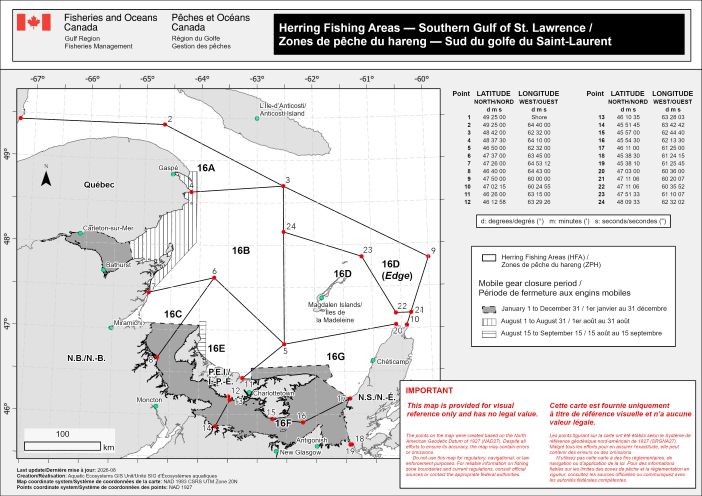
- From January 1st to December 31st, fishing is prohibited in a portion of Herring Fishing Area (HFA) Edward Island (see Chart 2).
- From January 1st to December 31st, fishing is prohibited west of the line between Grande-Anse, New Brunswick and Paspébiac, Quebec (see Chart 2).
- From August 1st to 31st, fishing is prohibited inside Chaleur Bay (see Chart 2).
Vessels smaller than 19.81 metres
Other management measures
- The Dockside Monitoring Program percentage coverage is 100%.
- The percentage of the spring spawners will be monitored for each fishing trip using a scientific protocol to determine catch composition (see Annex 1).
- The fall fishery for the small seiners will be closed for the season (for fleets using mobile gear) when either of the following occurs:
- exceeding 10% of spring spawner by-catch per fishing trip for two consecutive trips, or
- a total amount of 25 t of spring spawner by-catch has been caught.
- The purse seine fishery is subject to the small fish protocol.
- The logbook is mandatory (paper or electronic format).
- Any allocation overrun in a given year is reconciled against the following season allocation.
Fishing restrictions
- From January 1st to December 31st, fishing is prohibited in a portion of Herring Fishing Area (HFA) 16G off the northeast coast of Prince Edward Island (see Chart 2).
- From January 1st to December 31st, fishing is prohibited west of the line between Grande-Anse, New Brunswick( NB) and Paspébiac, Québec (see Chart 2).
- From August 1st to 31st, fishing is prohibited inside Chaleur Bay (see Chart 2).
ANNEX 1
SCIENTIFIC PROTOCOL TO IDENTIFY THE SPRING SPAWNER COMPONENT DURING THE HERRING FALL FISHERY
The following biological sampling of herring is required for each landing by the Gulf purse seine fleet during the fall fishery:
- A total of at least 200 herrings, randomly selected, must be sampled for each trip.
- In the event no DFO port samplers are available to collect the fish at landing, all the herring samples taken must be placed in a few well-identified plastic bags then inside a sample box. Requested information must be recorded directly on the box. Each box should be frozen as quickly as possible and stored.
- All pertinent information, such as the vessel name, date and time of the catch, fishing area, and especially the position coordinates (latitude /longitude) where the herring was caught must be provided.
- If a port sampler is available, DFO is responsible for transporting the samples to the Gulf Fishery Centre in Moncton (GFC). Otherwise, the fishers will be responsible for shipping the frozen samples to the GFC.
- A logbook form must be filled out for each trip.
Chart 1
Sectors and area inside Chaleurs Bay
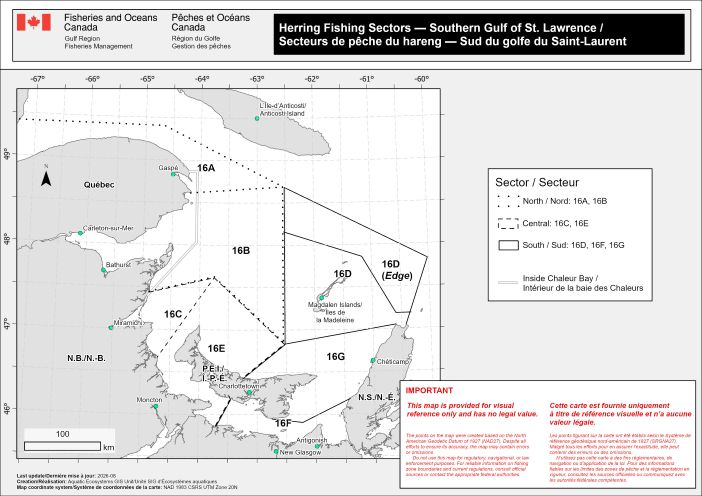
Chart 2
Fishing restrictions and closures