
Frequently asked questions (FAQ) about striped bass
Striped bass is a native species to the Miramichi River system. As a result of effective management and fisheries closures, its population has recovered significantly from critically low levels of the late 1990s and early 2000s. The recovery of striped bass in the southern Gulf of St. Lawrence is a great success, which led to the reopening of Indigenous and recreational fisheries, bringing economic benefits to the region.
FAQ on the striped bass recreational fishery
Q1: Where am I allowed to fish for striped bass in the southern Gulf of St. Lawrence?
Q2: Do I need an angling license to fish striped bass?
Q3: When can I fish for striped bass?
Q4: Is the fishery open all hours of the day during the season?
Q5: What is the daily bag and possession limit?
Q6: Why is the catch size 50 to 65 centimetres during the retention fishery?
Q7: Can I cut and fillet my catches on the shore or aboard my boat?
Q8: Can I fish with natural bait?
1. Question: Where am I allowed to fish for striped bass in the southern Gulf of St. Lawrence ?
Answer:
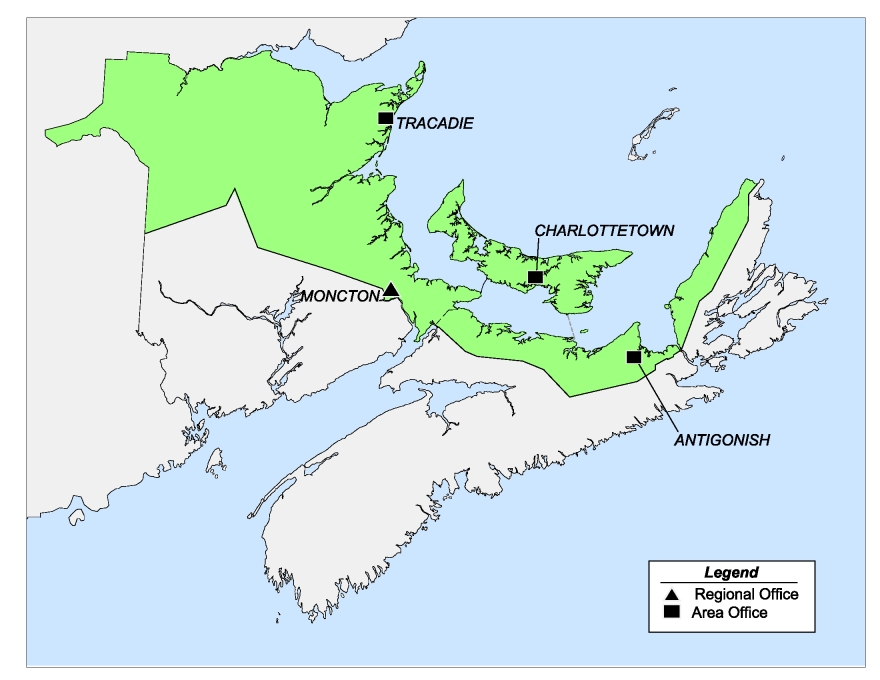
Striped bass may be fished in the inland and tidal waters of the provinces of New Brunswick (NB), Nova Scotia (NS) and Prince Edward Island (PEI) in the southern Gulf of St. Lawrence.
2. Question: Do I need an angling license to fish striped bass?
Answer:
To fish striped bass in tidal waters, you do not need a license. However, to fish in inland waters, you will need an angling license issued by the province you will be fishing in. Please call or visit the provincial natural resource department for more information on angling licenses. This information can also be found in the angling book of each respective province.
Provincial Links:
3. Question: When can I fish for striped bass?
Answer:
The season varies depending on whether you are fishing in inland waters or tidal waters. Here are the dates:
- Tidal waters adjacent to N.B., P.E.I. and N.S. in the southern Gulf of St. Lawrence: April 15 to October 31.
- The inland water season for NB and NS rivers in the Gulf Region is May 1 to September 15 (except for the entire Miramichi River system where the season is April 15 to October 15). In the inland waters of PEI, the season is from April 15 to September 15.
4. Question: Is the fishery open all hours of the day during the season?
Answer:
No. Angling is closed during the night.
For recreational fishing in tidal waters from April 15 to June 30, angling activities can begin 2 hours before sunrise and must end no later than 2 hours after sunset of each day. From July 1 to October 31, angling activities are permitted from 04:00 hrs to 00:00 hrs (midnight), except in the tidal waters of the Miramichi river (including the southwest and northwest Miramichi rivers) upstream from the Centennial bridge.
For recreational fishing in inland waters, angling activities can begin 2 hours before sunrise and must end no later than 2 hours after sunset of each day, including in the tidal waters of the Miramichi River (including the southwest and northwest Miramichi rivers) upstream from the Centennial Bridge.
5. Question: What is the daily bag and possession limit?
Answer:
For the recreational fishing season, recreational anglers may retain a maximum of 4 legally sized striped bass (total length of 50 to 65 cm) per day and it will be prohibited to have more than 4 striped bass in your possession any time from April 15 to October 31.
6. Question: Why is the catch size 50 to 65 centimetres during the retention fishery?
Answer:
A maximum catch size of 65 centimetres has been set to protect the large spawners that produce the largest amount of eggs. A minimum catch size of 50 centimetres has been set to minimize the catch of fish that are not yet mature. Striped bass total length is measured in a straight line from the tip of the nose to the tip of the tail (one of the two tips of the tail, without any particular manipulation to the tail).
7. Question: Can I cut and fillet my catches on the shore or aboard my boat?
Answer:
No. Many recreational fisheries, including the striped bass fishery in the Gulf Region, have quota and length restrictions as a conservation measure. Fishery officers on patrol may inspect your catches to identify the species and verify compliance with quota and length restrictions. For that reason, except for gutting, it is prohibited to possess recreationally caught striped bass that have been skinned, cut, packed, or otherwise dealt with (including filleting) prior to returning to one’s residence or accommodations after recreational fishing. Failure to comply with this requirement may result in prosecution.
8. Question: Can I fish with natural bait?
Answer:
Yes, but there are some restrictions on this fishing method. It is mandatory to use barbless hooks when natural bait or lures are used to catch striped bass in tidal waters. This measure reduces the risk of injury to released fish. However, it is recommended to use barbless non-offset circle hooks.
FAQ on the southern Gulf of St. Lawrence striped bass population
Q1: Has the striped bass population exploded?
Q6: Is there only one striped bass spawning location in the southern Gulf of St. Lawrence?
1. Question: Has the striped bass population exploded?
Historically, striped bass abundances were more similar to what has been observed over the past decade than the decades preceding it when abundances were very low. For example, in 1917, 61 tons of striped bass were harvested, equivalent to between 65,000 and 200,000 fish depending on their sizes.
However, the striped bass population was unable to support this level of fishing pressure and was eventually shut down completely in 1996 when the population plummeted to just a few thousand spawning fish.
Starting in the mid-2010s, the spawning population began to gradually increase and is now generally estimated to be in the 300,000 to 500,000 range, with considerable fluctuations from year-to-year.
While the number of striped bass located in the Miramichi River during spawning is remarkable, it is important to remember that they are only there for a relatively short period of time, and that they represent the whole spawning population for the southern Gulf of St. Lawrence.
After spawning in early June, the majority of fish head to coastal waters throughout the southern Gulf of St. Lawrence where they feed until the Fall. At that time, many striped bass will return to the Northwest Miramichi to overwinter in preparation for spawning the subsequent Spring, though striped bass overwinter in many other bays and estuaries as well.
Please see the latest striped bass stock updates for more information: Science Responses.
2. Question: What do striped bass eat?
Answer:
Striped bass feed opportunistically on a wide variety of plankton, insects, fish, and crustaceans. The size of the prey increases as striped bass grow, starting with zooplankton and larval fish, then progressing to small fish, shrimp and other crustaceans as the bass develop. Striped bass are generalist predators and will eat available prey in proportion to its availability in the environment.
Recent studies on the predator-prey interaction between native striped bass and Atlantic salmon (smolts) in the Miramichi River have provided direct and indirect evidence that striped bass consume, amongst other prey, variable numbers of emigrating salmon smolts annually. The degree to which this natural predator-prey dynamic is limiting the number of adult salmon returning to the Miramichi river is unclear. The survival of smolts in the ocean environment continues to be very low across the species range.
3. Question: Is striped bass an invasive species to the Miramichi River and the southern Gulf of St. Lawrence?
Answer:
No. Striped bass are native to the southern Gulf of St. Lawrence. At the end of the last ice age, approximately 20,000 years ago, 19 freshwater and 9 diadromous fish species, including Atlantic salmon and striped bass, colonized the Maritime Provinces’ rivers and have co-evolved since then. Complex relationships have developed between striped bass and other species – however, those relationships are not fully understood and are changing alongside the climate (see Question 5 for more details).
4. Question: Are striped bass really the cause of Atlantic salmon decline? Can Atlantic salmon and striped bass coexist on the Miramichi River?
Answer:
Striped bass are not responsible for the decline of Atlantic salmon. While they, like other predators, contribute to salmon mortality, broader environmental and ecological factors are driving the widespread decline in salmon populations—to historic lows in most areas—including rivers where striped bass are not present. In the Miramichi River, Atlantic salmon and striped bass have coexisted for thousands of years, including during times when both species were thriving. However, since the 1970s, Atlantic salmon populations have been declining across their entire range, including the Miramichi River.
5. Question: How will climate change impact striped bass and Atlantic salmon?
Answer:
There are still a lot of uncertainties around how climate change will impact the two species. However, climate change and rising temperatures may be having different impacts on Atlantic salmon and striped bass.
Atlantic salmon prefer cooler waters, and the Gulf Region is now towards the southern limit of their freshwater distribution. In recent years, river temperatures have sometimes exceeded 30°C within the Miramichi River watershed, temperatures that can be lethal to adult Atlantic salmon if they’re exposed to them for too long. A warm water prohibition on catch-and-release fishing for the protection of Atlantic salmon from a high risk of post-angling mortality is put in place when water temperature exceeds certain temperatures. Angling at water temperatures above 18°C increases the chance of a temperature-related death from fishing stress.
On the other hand, striped bass may benefit from warming coastal waters, given that the majority of the species’ range is to the South where water is typically warmer than in the southern Gulf of St. Lawrence. Eventually, striped bass could potentially expand their distribution northward where it has been too cold historically. For example, striped bass originating from the Miramichi River were observed in Newfoundland and Labrador for the first time in 2017, though there were no signs of spawning there.
6. Question: Is there only one striped bass spawning location in the southern Gulf of St. Lawrence?
Answer:
Yes. While striped bass eggs and larvae have been observed in other bays and estuaries within the southern Gulf of St. Lawrence, to this day, no study has been able to detect juvenile fish originating from rivers other than the Northwest Miramichi.
Striped bass require specific environmental conditions to spawn (e.g., warm, brackish water, and a moderate current). For successful reproduction to occur, eggs and larvae need to remain suspended in water for between 10-14 days. Within New Brunswick and Nova Scotia there are only a handful of locations where all these criteria are met and where striped bass spawn successfully, and include the Saint John River, Saint Lawrence River, Stewiacke/Shubenacadie River, and the Northwest Miramichi River. In the Gulf Region, the Northwest Miramichi estuary is the only area where these conditions are met consistently.
The existence of only one successful spawning ground makes this population vulnerable. It is always possible that poor environmental conditions in a given year or over multiple years, may result in low or no spawning success that could severely impact the health of the stock. The Northwest Miramichi has hosted successful spawning for at least hundreds of years, and in that timeframe there hasn’t been significant spawning anywhere else in the Gulf Region, to our knowledge.
7. Question: I’ve heard a lot about Atlantic salmon declining in the Miramichi River and many people blame striped bass. Are Atlantic salmon only declining here?
Answer:
Atlantic salmon are in decline and are at historic lows throughout the majority of their range in the North Atlantic Ocean, which includes rivers throughout North America and Europe. Atlantic salmon smolt survival and growth to the adult life stage in the ocean environment continues to be very low across this range. Poor marine survivorship is considered the main factor limiting Atlantic salmon recovery globally.
Stressors in the freshwater environment are also negatively affecting Atlantic salmon. Increased river temperatures linked to climate change, coupled with habitat degradation, and freshwater acidification may all be having a negative impact on salmon populations, depending on their location.
For more information, please check our Frequently Asked Questions (FAQ) about Atlantic salmon.